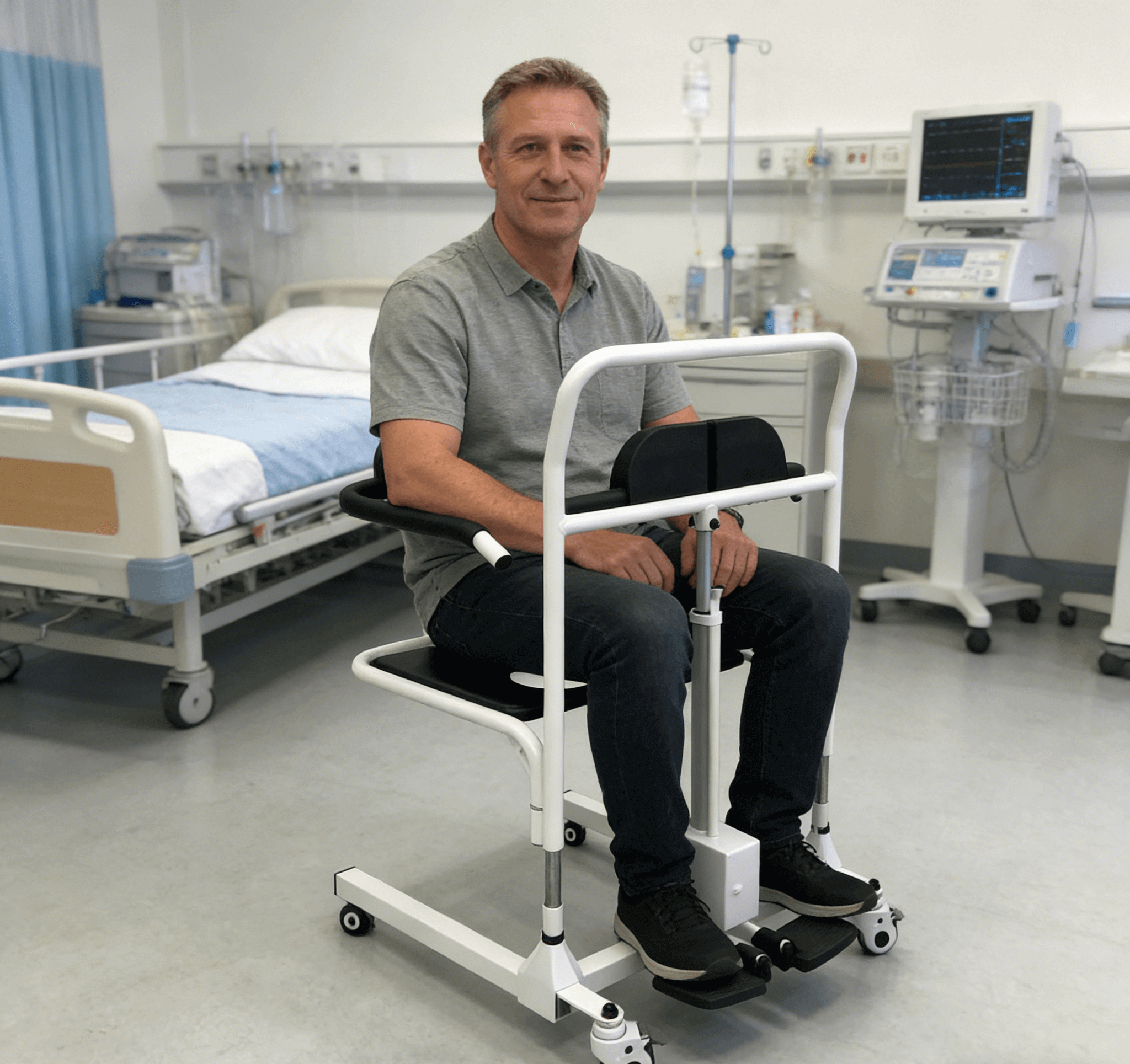
Category: Power Wheelchair
Posted by 2025-12-25 11:12
hoyer lift for truck
Hoyer Lifts and Truck Transfers: Professional Solutions for Vertical Challenges
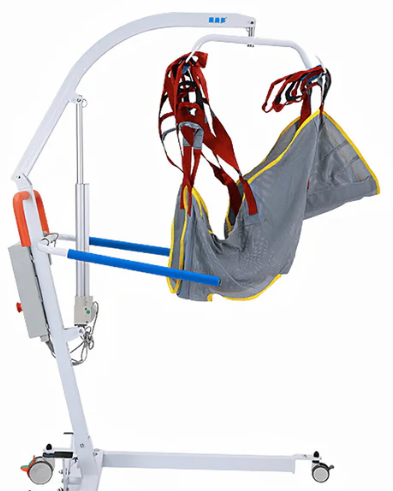
For individuals with mobility impairments who need to drive or ride in trucks, getting in and out of the tall truck cab is an arduous and even dangerous task. Standard Hoyer Lifts, due to their design limitations, hoyer lift for truck are not built for this purpose. However, with professional equipment and clever modifications, safe and independent access to and from trucks is entirely achievable. This article will guide you through the solutions for this specific scenario.
I. Why Are Standard Hoyer Lifts Unsuitable for Trucks?
Insufficient Height
The height of a truck cab floor from the ground is far greater than that of a regular bed or wheelchair. The boom height of standard lifts is completely inadequate to lift users to the required position.
Stability Risks
On potentially uneven ground (such as parking lots or job sites), lifting users to a high elevation significantly raises the lift’s center of gravity, greatly increasing the risk of tipping.
Limited Operating Space
Space around trucks may be limited, making it difficult for standard lifts to approach and operate.
Inability to Address the "Final Step"
Even if users are barely lifted to the required height, horizontally transferring them into the driver’s seat is extremely challenging.
II. Professional Wheelchair-Accessible Solutions for Trucks
To tackle this unique challenge, there are several engineering-proven specialized solutions available on the market:
1. Truck Side Lift Platforms
Description: This is an electric platform installed on the side of the truck (usually replacing or adjacent to the cab door). Users move their wheelchairs to the front of the platform, secure the wheelchair to the platform, and then the platform smoothly lifts vertically to the height of the cab floor.
Advantages:
High independence: Users can operate it independently without assistance from others.
Wheelchair-carrying capability: It can lift both the user and the wheelchair directly, solving the dual problems of transfer and wheelchair storage.
Stability and safety: Specifically designed for vehicles, hoyer lift for truck it offers extremely high stability and safety.
Considerations: Requires professional vehicle modification and involves high costs.
2. Swivel Seat Transfer Systems
Description: This is one of the most integrated and elegant solutions. The original driver’s seat is replaced with an electric base. When a button is pressed, the entire seat:
Rotates toward the door (usually by 90 degrees).
Lowers to a height close to the ground outside the door.
Advantages:
Seamless transfer: Users can slide directly from their wheelchair into the seat (or with minimal assistance) before the seat automatically swivels and lifts back to the driving position.
Extreme convenience: Operation is simple and fast, almost the same as getting into a normal vehicle.
No change to vehicle appearance: The system is fully built-in.
Considerations: This is one of the most costly options and requires in-depth vehicle modification.
3. Portable Truck Step Lifts
Description: This is a relatively lightweight device that can be temporarily placed on truck steps. It typically consists of an electric seat that runs on a track, moving up and down along the truck’s original step path.
Advantages:
No permanent modification required: Suitable for users who need to drive different trucks.
Solves step-related issues: Perfectly addresses the challenge of multi-level steps.
Considerations: The device still needs to be transported to the site and requires a certain amount of setup time.
III. If a Lift Must Be Used: Key Safety Measures
In rare cases where a mobile lift (e.g., in a workshop) must be used to transfer someone into a truck cab, hoyer lift for truck safety is the absolute top priority:
Industrial-grade equipment only: Heavy-duty lifts with sufficient load capacity and stable bases must be used—ordinary household models are strictly prohibited.
Perfect ground conditions: Operation must be conducted on absolutely solid, level, and dry concrete surfaces.
Professional operators: The transfer must be performed by personnel with specialized training and familiarity with high-risk operations.
Secondary protection: Consider using safety ropes or harnesses as additional fall protection.
Strict prohibitions: Never attempt this operation on muddy, gravel, or sloped ground.
IV. Selection and Planning Guide
Assess Needs
Do you only need to access the cab, or do you also need to carry a wheelchair? Do you often drive the same vehicle?
Consult Experts
Contact professional vehicle wheelchair-accessible modification companies. They are authorities in this field and can provide the most suitable solutions based on your vehicle model and needs.
Cost-Benefit Analysis
Consider the balance between the one-time investment in modifications and the independence, work efficiency, and safety they bring.
Explore Funding Opportunities
In some cases, government veteran benefits, hoyer lift for truck vocational rehabilitation programs, or insurance may cover part of the modification costs.
Conclusion
While standard Hoyer Lifts cannot solve the challenge of accessing trucks, modern accessible technology offers powerful and reliable solutions. From side lift platforms to swivel seat systems, these devices—designed for harsh environments—can empower drivers and passengers with mobility impairments to gain complete freedom, allowing them to safely and dignifiedly return to the cab and continue pursuing their careers and lives on the road. Investing in the right modifications is an investment in boundless mobility and independence.